
Radiation modeling
This lesson explains the two Radiation simulation object types and how each defines radiative enclosures and affects radiation calculation efficiency.
This lesson may include hands-on exercises. Review the Discussion section for background information or click the button to proceed to the practical section.

Discussion
Thermal radiation is a mode of heat transfer that does not require a physical medium. It can occur in air, gas, or vacuum and it travels at the speed of light. Surfaces can emit, absorb, and reflect thermal radiation depending on their temperature, emissivity, and surrounding geometry.
Radiation can be an important heat-transfer mechanism in gas turbine applications, particularly where components have large temperature differences and a direct line of sight. It is also important when convective heat transfer is reduced, such as during shutdown or low-flow operating conditions. Typical turbomachinery regions where radiation may be significant include:
- Exhaust assemblies, where diffuser walls are hot and outer casings are relatively cool.
- Turbine inlet regions, where flowpath components are exposed to combustion flames or other hot combustion hardware.
For two radiating surfaces, the net radiative heat transfer between the surfaces is computed as:
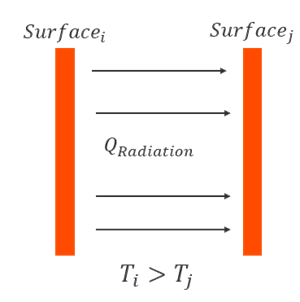
Where:
- is the Stefan–Boltzmann constant.
- and are the absolute temperatures of surfaces i and j.
- and are the surface areas..
- and are the surface emissivities.
- is the radiation view factor from surface i to surface j.
Accurate radiation modeling requires both appropriate optical properties and reliable numerical methods for calculating radiative exchange.
- Thermo-optical properties
- Thermo-optical properties define how a surface emits, absorbs, reflects, and
transmits radiation. These properties can be defined as gray, where values
are independent of wavelength, or non-gray, where properties vary with
wavelength, direction, or angle of incidence.
Simcenter 3D supports advanced thermo-optical modeling, including temperature-dependent emissivity, wavelength-dependent properties, and multiple optical property states. These capabilities are essential when modeling applications such as solar heating, multilayer insulation, or materials with strong spectral variation.
- Modeling radiation in turbomachinery
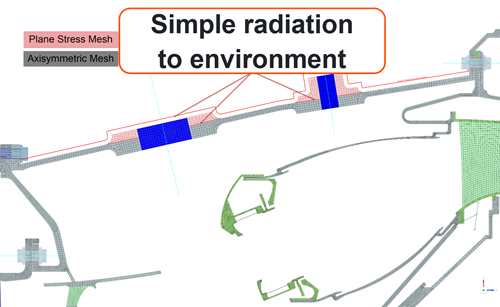
- Use the Simple Radiation to Environment on internal
edges of 2D meshes to model radiation from hot components to a surrounding
environment. The thermal solver uses the internal line treatment to compute
the area from which radiation occurs.
Use Radiation to model radiation between surfaces in enclosures, where components exchange radiation with each other.
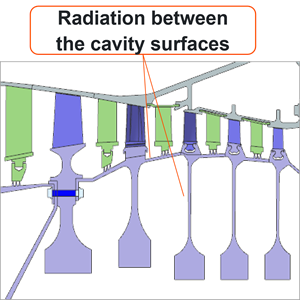
There are two types:
- All Radiation to automatically detect enclosures based on element sides with defined thermo-optical properties. This option is suitable for models that form a single complete enclosure and do not require explicit modeling of radiation leaving the enclosure.
- Enclosure Radiation to explicitly define physical enclosures. This approach improves efficiency by reducing the size of the radiation matrix.
- Radiation methods
- Several numerical methods are available to calculate view factors and
radiative exchange, including:
- Hemicube Rendering to compute the radiative view factors using radiosity algorithms in the computer’s graphic card, allowing for the quick and accurate calculation of shadowed view factors.
- Deterministic to calculate view factors by iteratively selecting element pairs.
- Monte Carlo that is a ray-casting or ray-tracing method used in many applications including the calculation of view factors.
- GPU Computed View Factors to compute the radiative view factors. The thermal solver initially computes the blackbody view factors assuming the body is perfectly black. Then, it adjusts them to account for the actual surface properties, resulting in gray-body view factors.
- GPU Computed Ray Tracing to perform ray tracing on the GPU to compute radiative conductances directly.
Each method provides a different balance between accuracy and computational cost. To better understand how to select a radiation computation method, use the following table.
Comparison parameters Hemicube Rendering Deterministic Monte Carlo GPU Computed View Factors GPU Computed Ray Tracing Computation device CPU CPU CPU GPU GPU Supported thermo-optical properties Diffuse properties Diffuse, specular, and transmissive properties All Diffuse properties, ignores transmissivity and specular properties Diffuse, specular, and transmissive properties Performance Fast Good Competitive with Hemicube for planar surfaces
Slow for diffuse properties and large models Competitive for specular and transmissive properties
Very fast Much faster than the Monte Carlo or deterministic methods, but slower than the GPU computed view factors method View factor results Yes Yes Only when specified Yes No Computation of radiative heat loads No Only used to compute geometric view factors for diffuse reflections
Yes Diffuse reflections calculated using geometric view factors
Yes Direct computation
No Yes Direct computation
Advantages Fast for large diffuse problems Computes shadowed view factors quickly and accurately
High accuracy for complex radiation Handles specular effects
Handles partial illumination of individual elements accurately Handles complex models of diffuse reflection and transmission, through definition of BRDFs and scattering in participating media
Supports axisymmetric 2D edge radaition modeling
Extremely fast Handles partial illumination of individual elements accurately
Very fast Models complex physical effects of real surfaces including reflection, transmission, absorption, solar and IR properties
Accounts for specular and transparent effects
Disadvantages Assumes uniform illumination per element; less accurate for complex shading Computationally expensive, slower on large models Inefficient for large models, requires significant computational resources Cannot model real surfaces effects Computationally more expensive than GPU computed view factors
Hands-on material
To gain experience with the topics discussed here, complete the following:

