
Radiation with cyclic symmetry
This topic explains how the thermal solver handles radiation in sector models that use cyclic symmetry.
This lesson may include hands-on exercises. Review the Discussion section for background information or click the button to proceed to the practical section.

Discussion
Use Cyclic Symmetry to model only one sector of a full 360-degree geometry. During radiation calculations, the solver must determine whether surfaces exchange radiation only within the modeled sector or also with replicated sectors around the full circumference.
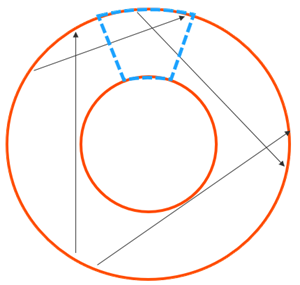
For radiation modeling with cyclic symmetry, it is also important to correctly define the stages associated with the cyclic sectors. The solver uses the stage definition to scale the model and compute the correct radiative areas and conductances for the full circumferential representation.
Radiation modeling depends on whether the radiative thermal rotation periodicity is enabled or disabled in the Cyclic Symmetry command.
- Radiative thermal rotational periodicity disabled
- When Enable Radiative Thermal Rotational Periodicity
is cleared, the solver:
- Computes view factors only for the modeled sector.
- Scales radiative conductances using the number of cyclic segments.
Use this option when surfaces radiate only within the same sector.
- Radiative thermal rotational periodicity enabled
- When Enable Radiative Thermal Rotational Periodicity
is selected, the thermal solver automatically:
- Replicates the sector around the full 360 degrees based on the defined cyclic symmetry.
- Computes view factors between the real sector surfaces and the replicated sector surfaces.
Use this option when sector surfaces radiate to:
- Adjacent sectors.
- Other components outside the modeled sector.
Hands-on material
To gain experience with the topics discussed here, complete the following:

