
Solving the model
This lesson introduces the numerical solution techniques used by the thermal solver for steady-state and transient thermal analyses.
This lesson may include hands-on exercises. Review the Discussion section for background information or click the button to proceed to the practical section.

Discussion
Simcenter 3D Space Systems Thermal uses a finite volume based thermal solver to compute steady-state and transient heat transfer solutions. The solver can handle linear and nonlinear thermal problems involving conduction, convection, and radiation. It generates thermal nodes from mesh elements, computes conductances based on geometry and material properties, assembles a global conductance matrix, and solves the resulting system of equations.
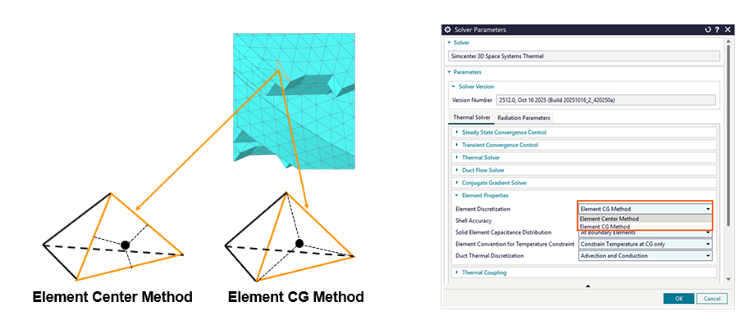
Before solving a model, you must define a solution, which specifies the analysis type, boundary conditions, and solver options. Simcenter 3D supports steady-state and transient thermal solutions. Initial conditions define the starting temperature state for nonlinear iterations, and restart options allow reuse of previous solution data to improve convergence or recover from interrupted runs.
Solver behavior and convergence are controlled using Solver Parameters, including convergence criteria, iteration limits, relaxation factors, and conjugate gradient settings. These parameters are critical for ensuring solution stability and efficiency, especially for nonlinear problems involving radiation. Specialized options are also available to control radiative heat transfer calculations and improve performance for large or complex models.
Hands-on material
To gain experience with the topics discussed here, complete the following:
 Demo video: Setting up a steady state heating analysis of the mars rover
 Define a thermostat in a steady state solution
-
Modify and solve a solution
-
Demo video: Setting up and solving a transient solution
-
Thermal transient analysis of a power supply using thermostat and active heat controller
-
Demo video: Thermal transient analysis of a power supply using thermostat and active heat controller
-
Troubleshoot the model
Further learning
 How to manage restarts and overcome challenges effectively?
-
Resolving warning 4410: Troubleshooting iterative heat flux convergence issues
-
Troubleshooting thermal convergence issues and invalid temperature distribution
-
Understanding the preconditioned conjugate gradient solver and convergence checks in temperature calculation
-
Model checks in Space Systems Thermal
-
How to improve the solution time for models with solar heating and radiation request?