
Articulation and motion modeling
This lesson introduces articulation and motion modeling to capture the thermal effects of moving and rotating components, including their impact on view factors, heat loads, and radiation.
This lesson may include hands-on exercises. Review the Discussion section for background information or click the button to proceed to the practical section.

Discussion
Articulation and motion modeling is used to account for thermal effects caused by the movement of spacecraft components during operation. As components move, rotate, or spin, their relative positions change, which directly affects view factors, radiative heat exchange, and thermal coupling behavior. Accurately modeling these effects is essential for systems such as deployable panels, solar arrays, antennas, and robotic mechanisms.
Motion-related thermal effects are modeled using the Solid Motion Effects simulation object. This object allows you to represent different types of motion, including articulated movement of selected elements, spinning of an entire model, or spinning of specific components within a model.
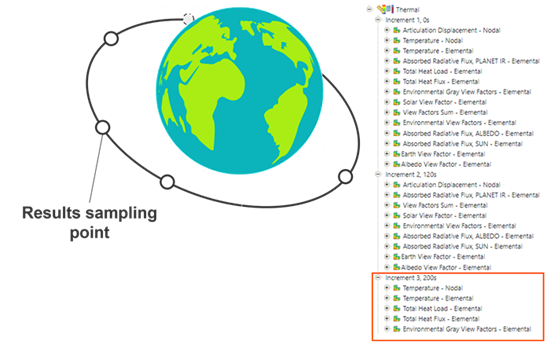
The Articulation type is used to model transient thermal effects caused by prescribed motion of selected elements. Articulation is defined through Joint or Joint-Orbital Tracker modeling objects, which specify rotational or translational motion and support complex kinematic relationships using parent–child joints. During articulation, the thermal solver updates radiative conductances, thermal couplings, and heat loads—such as radiative and solar heating—at each articulated position.
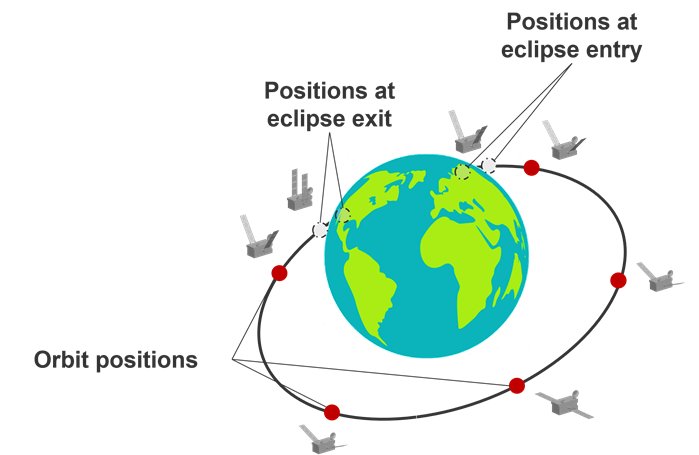
- The number of orbit positions.
- The presence of an eclipse in the orbit. The solver computes two additional calculation positions for eclipse entry and two more for eclipse exit.
Hands-on material
To gain experience with the topics discussed here, complete the following:

