
Orbital modeling
This lesson explains how to define orbit parameters and solar and celestial body characteristics to establish spacecraft position, orientation, and environmental conditions for space thermal analysis.
This lesson may include hands-on exercises. Review the Discussion section for background information or click the button to proceed to the practical section.

Discussion
- Orbit definition
- Orbit definition is a fundamental step in space thermal analysis because it
determines the spacecraft position, orientation, and environmental exposure
over time. Orbit parameters are defined using an
Orbit modeling object, which specifies the
spacecraft trajectory around a celestial body and its relationship to the
Sun and planet.The Orbit modeling object allows you to define full orbits, orbit segments, and orbital maneuvers. It also supports the definition of spacecraft attitude, calculation positions along the orbit, and time-dependent sun and celestial body vectors. These parameters directly influence solar loading, planetary albedo, and infrared radiation effects.
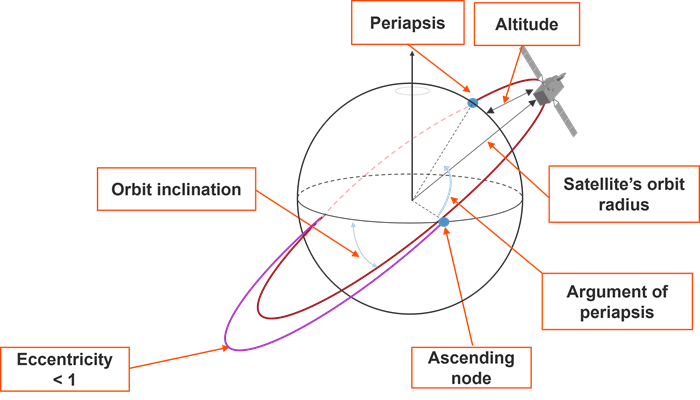
Several orbit types are available to represent common mission scenarios. These include Beta Angle, Geostationary, Geosynchronous, Classical, Sun-Synchronous, Shuttle, and Molniya orbits. Depending on the selected type, the software automatically defines or allows you to specify parameters such as altitude, orbital radius, eccentricity, inclination, argument of periapsis, period, and satellite position.
For most orbit types, the satellite position is defined relative to the ascending node, which is the point where the spacecraft crosses the equatorial plane from the southern to the northern hemisphere. Parameters such as right ascension of the ascending node and local time at the ascending node are used to establish the spacecraft orientation with respect to the Sun and planet.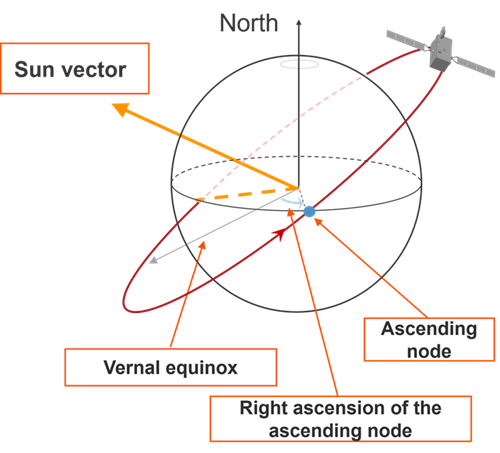 In addition to orbit geometry, solar and celestial body characteristics must be defined. These properties include planet size, rotation period, gravity, albedo flux, solar declination, sun right ascension, and solar flux. For Earth-based analyses, specifying either the solar declination or the sun right ascension is sufficient. Once the sun position is defined, the thermal solver can compute the corresponding solar flux, which can be adjusted if required.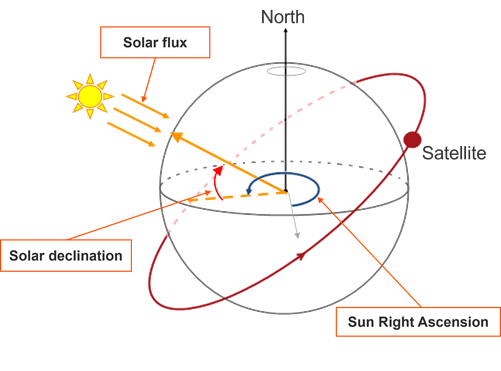
Together, orbit parameters and solar and planetary characteristics define the thermal environment experienced by the spacecraft and provide the foundation for accurate radiation and heating calculations.
- Orbital heating
- Orbital heating is defined using the Orbital Heating
simulation object. This object computes orbital view factors, heat fluxes,
and temperatures for illuminated surfaces within a defined orbit. It
automatically accounts for eclipses, spacecraft rotation or spinning, and
uses ray tracing to model specular reflections and transmissions of
collimated solar radiation.
Solar heating is computed based on the spacecraft exposure to direct sunlight, while planetary albedo accounts for reflected solar radiation from the planet’s surface. Planetary IR radiation models the infrared energy emitted by the planet. These contributions are combined to establish the external thermal loads acting on the spacecraft during its orbit.
To define orbital heating, you specify the illuminated entities, select an Orbit modeling object that defines the spacecraft trajectory, attitude, and environmental characteristics, and choose a calculation method for computing view factors. Because ray tracing is required for solar heating, Deterministic or Monte Carlo methods are used, and Hemicube Rendering is not supported.
Orbital heating calculations provide the external heat inputs to the thermal model. Heat leaving the spacecraft toward space is handled separately using a Radiation Enclosure simulation object. After solving, orbital thermal results can be visualized and animated using the Orbit Visualizer, allowing you to review spacecraft orientation, illumination, shadowing, and thermal response throughout the orbit.
Hands-on material
To gain experience with the topics discussed here, complete the following:


