
Defining thermal contacts
This lesson introduces thermal couplings and explains how conduction, convection, and radiation couplings are used to model heat transfer between unconnected or simplified regions of a model.
This lesson may include hands-on exercises. Review the Discussion section for background information or click the button to proceed to the practical section.

Discussion
Thermal contacts are modeled using thermal couplings. A thermal coupling represents a conductance between unconnected or non-aligned elements and is used to simulate heat transfer without explicitly modeling the heat transfer medium. The coupling conductance is computed based on user-defined values and the area of overlap between the selected element sets.
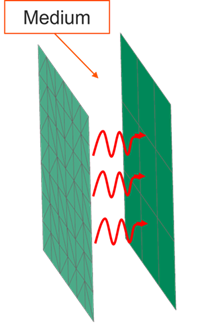
Thermal couplings are particularly useful when geometric connections are geometrically complex but thermally simple, or when it is unnecessary to represent full three-dimensional heat conduction.
- Thermal Coupling types
- Conductive thermal couplings explicitly create conductances between
selected faces or edges. These couplings may represent known conductance
values, additional conductances, or interface resistance.
Interface resistance can be applied to free or shared faces of 3D polygon bodies or to edges of 2D polygon bodies. Conductive couplings can be defined using total resistance, conductance per unit length, or gap conductance values.
Hands-on material
To gain experience with the topics discussed here, complete the following:


