
Connecting 3D cyclic bodies to other 3D cyclic bodies
This topic explains methods for connecting 3D cyclic bodies with different sector sizes using direct thermal coupling, 1D ducts, or 2D axisymmetric elements to transfer heat across cyclic interfaces.
This lesson may include hands-on exercises. Review the Discussion section for background information or click the button to proceed to the practical section.

Discussion
- Direct thermal coupling between cyclic sectors.
- Thermal coupling with a 1D duct, if temperatures are not circumferentially uniform.
- Thermal coupling with 2D axisymmetric elements, if temperatures are not circumferentially uniform.
- Applying thermal coupling directly between sector faces
- You can use Thermal Coupling directly between sector
faces to transfer heat across cyclic interfaces without using periodic
temperature boundary conditions.
To create thermal coupling between sector faces:
- Select the face of the larger sector as the primary region.
- Select the face of the smaller sector as the secondary region.
- Clear the Only Connect Overlapping Elements option.
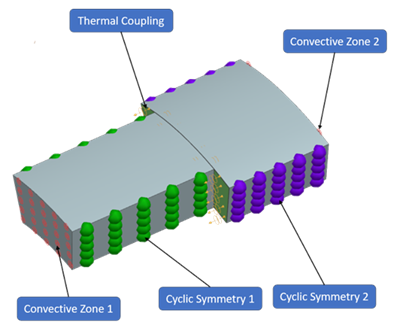
Use a high heat-transfer coefficient to approximate strong thermal continuity across the interface.
This approach:
- Provides a simple and efficient setup.
- Works best for circumferentially uniform thermal fields.
- Reduces model complexity compared to fully periodic thermal coupling methods.
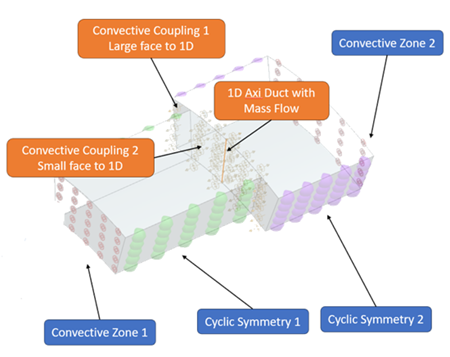
- Applying thermal coupling with 1D duct
- You can introduce a 1D axisymmetric duct with mass flow to create a
physically meaningful heat-transfer path between sector interfaces. This
approach allows the model to capture circumferential thermal nonuniformity
while maintaining compatibility with cyclic sector modeling.
Use Thermal Coupling - Convection to connect the sector faces to the duct:
- Create one convection coupling between the large sector face and the 1D duct.
- Create a second convection coupling between the small sector face and the 1D duct.
- Assign appropriate heat-transfer coefficient (HTC) values to maintain equivalence with the baseline cyclic solution.
For example, use approximately 2× HTC to reproduce the baseline cyclic thermal response.
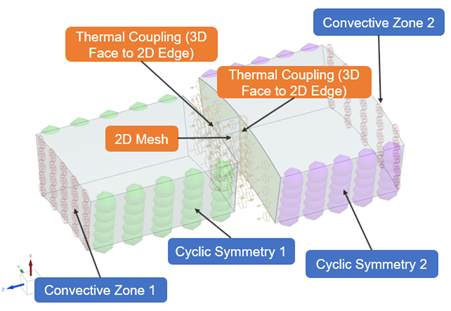
- Applying thermal coupling with 2D axisymmetric elements
- You can introduce a 2D axisymmetric mesh between neighboring 3D cyclic
sectors to model circumferential heat transfer with high accuracy. This
approach creates a continuous thermal conduction path between sectors and
provides the best representation of circumferential thermal
gradients.
Create a 2D axisymmetric mesh between adjacent 3D sector faces.
Use Thermal Coupling to connect the 3D faces to the 2D axisymmetric edges:
- Select the 3D face as the primary region.
- Select the 2D edge as the secondary region.
- Create one coupling for each sector interface.
The 2D mesh acts as an intermediate thermal conduction layer between the cyclic sectors.
This approach:
- Provides the highest-fidelity representation of circumferential heat transfer.
- Captures circumferential thermal gradients accurately.
- Produces results that closely match full 360-degree thermal behavior.
Hands-on material
To gain experience with the topics discussed here, complete the following:
