
Modeling the lunar surface thermal environment
This article provides recommendations for modeling the lunar thermal environment in Simcenter 3D Space Systems Thermal. It describes how to represent the lunar environment and regolith, account for interactions between the lunar surface and a vehicle, such as a rover or lander, and select an appropriate modeling approach for operational and lunar-night analyses.
Understand the lunar thermal environment
The lunar thermal environment is dominated by radiation. Because the Moon has essentially no atmosphere, atmospheric convection and scattering of sunlight are not considered. As a result, shadows are sharp and can produce large local temperature differences.
The low thermal conductivity of lunar regolith further increases the temperature difference between illuminated and shadowed regions. The long lunar day-night cycle also exposes vehicles to extended periods of heating and cooling.
For a lunar surface model, consider the following thermal effects:
- Direct solar radiation.
- Solar radiation reflected by the lunar surface (albedo).
- Radiation to deep space.
- Infrared radiation from the lunar surface.
- Radiative interaction between the vehicle and the lunar surface.
Lunar surface and subsurface conditions vary with location. Select environmental conditions and regolith properties appropriate to the mission latitude and region.
Atmospheric convection, atmospheric solar attenuation, and diffuse sky radiation are not required for the lunar environment.
Define the lunar environment
Use Solar Heating Space to define the solar and planetary environment. For the Moon, direct solar radiation reaches the model without atmospheric attenuation.
Define the Moon as the planetary environment and specify the following parameters required to determine the Sun position and the incident solar flux throughout the lunar day:
- Model latitude and orientation.
- Solar declination.
- Sun right ascension angle.
- Solar flux.
For radiation to space, define the Radiative Environment Temperature in the ambient conditions. Also define the lunar surface optical properties required to calculate absorbed and reflected solar radiation.
The solar heating calculation does not account for infrared energy emitted by the lunar surface and received by the vehicle. When this heat transfer is important, include the lunar surface explicitly in the thermal model.
Model the lunar surface
The level of detail required for the lunar surface depends on the purpose of the analysis.
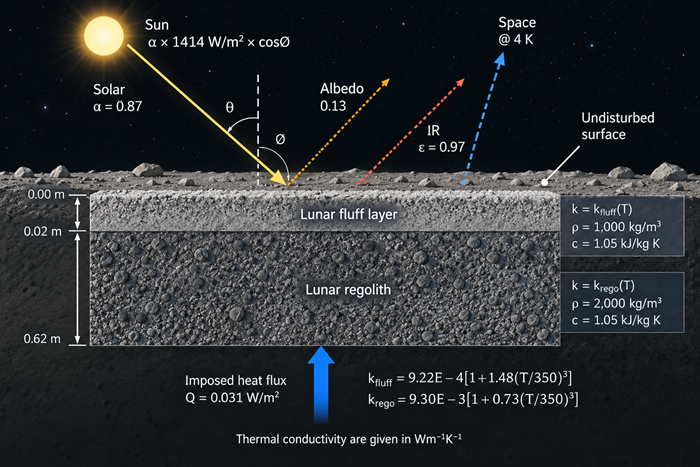
For analyses where the surface temperature and its interaction with the vehicle are important, represent the lunar surface using a layer of lunar fluff over the underlying regolith.
A detailed lunar surface representation described in the supporting work is listed in the following table.
| Layer | Thickness |
|---|---|
| Fluff | 20 mm |
| Regolith layer 1 | 60 mm |
| Regolith layer 2 | 80 mm |
| Regolith layer 3 | 160 mm |
| Regolith layer 4 | 320 mm |
Use one solid-element layer for the fluff and progressively thicker solid-element layers for the regolith.
For this representation:
- Define temperature-dependent thermal conductivity for the lunar fluff and regolith.
- Define the appropriate density and specific heat.
- Define the solar absorptivity and infrared emissivity of the surface.
- Include lunar albedo.
- Apply the geothermal heat flux at the bottom of the regolith when using the detailed model. In this example, a geothermal heat flux is 0.031 W/m2 at the bottom of the regolith.
The material properties and boundary conditions used for this representation are illustrated in the following image.
Select the appropriate regolith depth
You do not need the complete regolith representation for every lunar analysis.
A reduced representation can be appropriate when the vehicle remains relatively warm and the analysis is primarily concerned with operational or daytime conditions. The surface temperature responds relatively quickly to environmental changes, while the deeper regolith responds much more slowly.
Select the level of subsurface detail based on the analysis objective as described in the following table.
| Analysis objective | Suggested approach |
|---|---|
| Preliminary or daytime analysis | Reduced lunar surface model may be sufficient |
| Warm operational vehicle | Surface and fluff layers may be sufficient |
| Detailed surface interaction | Explicit temperature-dependent lunar surface |
| Lunar-night survival | Full regolith model |
| Long-duration transient analysis | Full model with appropriate initial temperatures |
Account for vehicle–surface interaction
Do not assume that the lunar surface remains at its undisturbed temperature when a vehicle is present.
A vehicle can modify its local thermal environment by:
- Shadowing the regolith and reducing absorbed solar energy.
- Radiating heat toward the lunar surface.
- Exchanging infrared radiation with locally heated or cooled regions of the surface.
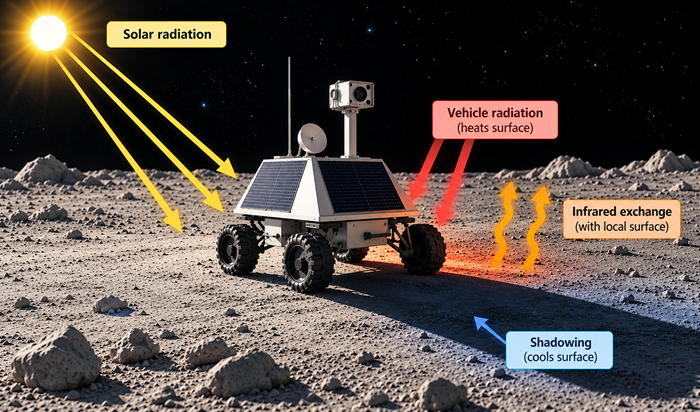
Because lunar regolith is dry and has low thermal conductivity, these effects can produce significant local surface temperature variations. In turn, the altered surface temperature can affect the radiative heat transfer and thermal performance of the vehicle.
Determine the extent of the lunar surface
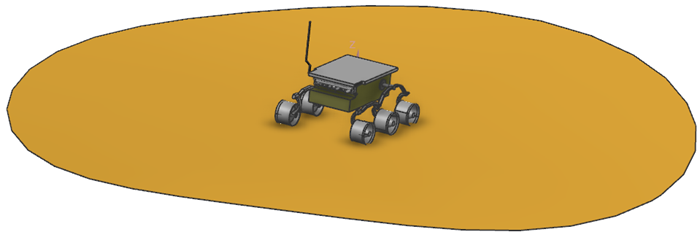
The modeled lunar surface must be large enough to represent the radiative environment surrounding the vehicle.
The required extent depends on factors such as:
- Size and geometry of the vehicle
- Height above the lunar surface
- Surface temperature
- Latitude and solar conditions
- Required accuracy
A surface that is too small can incorrectly represent the radiative view from the vehicle to the lunar terrain and deep space. The required extent can also vary with lunar surface temperature.
Perform a sensitivity study by progressively increasing the modeled surface extent. Use a surface size for which further increases do not significantly change the temperatures or heat loads of interest.
Choose between steady-state and transient analysis
Select the solution type according to the physical behavior that you need to evaluate.
Use a steady state analysis
A steady-state analysis can be appropriate for a stationary vehicle when you need to evaluate a particular operating condition and the lunar surface near the vehicle is sufficiently close to thermal equilibrium.
The lunar surface can approach its local equilibrium relatively quickly even though the deeper regolith remains transient. Therefore, the accuracy required for the subsurface temperatures should be considered separately from the accuracy required for the surface-vehicle interaction.
When using a detailed regolith model in a steady-state solution, consider prescribing an appropriate temperature at the bottom layer. Obtain this temperature from a transient analysis or another appropriate source.
Use a transient analysis
Use a transient analysis when the thermal history is important, such as for:
- Lunar-night survival
- Sunrise or sunset
- Heater activation and duty cycles
- Extended shadowing
- Long-duration surface operations
The deeper regolith layers can require a long simulation time to establish their periodic thermal state. Initialize the layers with representative temperatures when available to reduce the time required for the model to stabilize.
For lunar-night survival analyses, simulate the transition from sundown through the night when you need to evaluate component temperatures, heater activation, or heater power requirements. This approach was also used for the lunar-night thermal analysis described in the supporting TVAC work.
Consider moving vehicles
For a moving rover, consider whether the surface remains in the vehicle's shadow long enough for its temperature to change significantly.
The thermal effect of a moving shadow depends primarily on the size of the shadow and the vehicle speed. For sufficiently short exposure times, changes in the local surface temperature can be small, and a simplified or fixed-temperature representation may be appropriate.
Use a variable-temperature lunar surface when the vehicle moves slowly, remains stationary for significant periods, or when local surface-temperature changes could affect the thermal quantities of interest.
Modeling recommendations in Simcenter 3D Space Systems Thermal
When modeling a lunar vehicle:
- Use Solar Heating Space to calculate the Sun position and direct solar loading for the selected lunar latitude and orientation.
- Define the Radiative Environment Temperature to represent radiation from the model to space. For the lunar environment, radiation to deep space is a primary heat-transfer path.
- Model the lunar surface explicitly when the temperature of the regolith affects the thermal solution. The solver does not calculate the infrared radiation emitted by the lunar surface unless the surface is represented in the thermal model.
- For a detailed lunar surface, represent the fluff and regolith as separate solid regions and assign temperature-dependent thermal conductivity to the corresponding materials.
- Apply the appropriate solar absorptivity, emissivity, and albedo to the lunar surface so that the solver can calculate the relevant solar and infrared exchanges.
- Make the modeled lunar surface sufficiently large to capture the relevant radiative view factors between the vehicle and the terrain. Verify the selected size with a sensitivity study rather than relying on a fixed surface dimension.
- Use a steady state solution when evaluating a specific stationary operating condition and the surface temperature is sufficiently close to equilibrium. For the deeper regolith, consider prescribing the temperature of the bottom layer when appropriate.
- Use a transient solution when the analysis depends on the lunar day/night cycle, lunar-night survival, heater operation, or the time-dependent response of the regolith.
- Use representative initial temperatures for the regolith layers to reduce long transient initialization times.
- For a moving rover, use a transient surface model only when the rover's speed and shadow duration can produce a meaningful change in local lunar surface temperature. Otherwise, a simplified surface-temperature representation may be sufficient.
- Pay particular attention to radiators with a direct view of the lunar surface. The thermal solver computes the radiative exchange based on the modeled surface temperature, so using a fixed ground temperature can affect predicted radiator heat dissipation.